










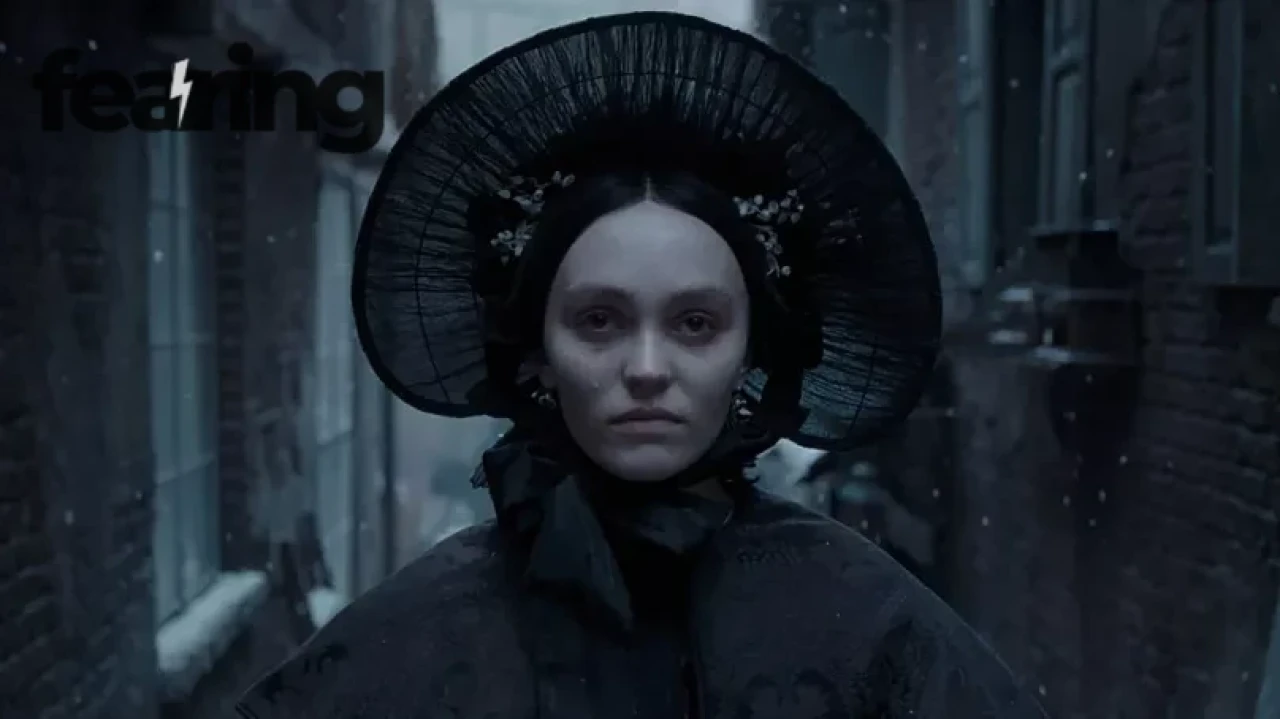
Nosferatu begins by piercing the myth of darkness and lineage. The keyword Nosferatu refers simultaneously to myth, monster, and obsession—so it anchors this film’s ambition. Under Robert Eggers’ direction, the 2024 version seeks to revive the horror legacy of the original 1922 classic with freshness, craftsmanship, and a modern edge.
Story and Setting
The film is set in 1838 Germany, where Ellen Hutter lives with her husband Thomas in the town of Wisburg. Thomas travels to the remote Carpathian Mountains on behalf of his employer Herr Knock to meet the reclusive Count Orlok and negotiate the acquisition of a manor in Wisburg. What he doesn’t know is that Orlok is far more than a nobleman. Ellen, meanwhile, has nightmares and a strange, latent connection to Orlok’s world—a world of plague, obsession, and secrets.
As the narrative unfolds, Orlok arrives in Wisburg and the terror begins—not merely as blood and fangs, but as an infestation of guilt, desire, and power.
Film Details
| Attribute | Information |
|---|---|
| Title | Nosferatu |
| Release Year | 2024 |
| Country of Origin | United States (with international co-production) |
| Language | English |
| Genre | Gothic Horror / Supernatural Thriller |
| Director | Robert Eggers |
| Main Cast | Bill Skarsgård (Count Orlok), Nicholas Hoult (Thomas Hutter), Lily-Rose Depp (Ellen Hutter), Aaron Taylor-Johnson, Emma Corrin, Willem Dafoe |
| Runtime | Approx. 132 minutes |
| Production Companies | Maiden Voyage Pictures, Studio 8, Birch Hill Road Entertainment |
| Distributor | Focus Features (US) / Universal Pictures (International) |
Themes and Symbolism
This version of Nosferatu pays homage to the original’s expressionist roots while exploring fresh themes:
Obsession and transformation: Orlok’s fixation on Ellen becomes a metaphor for power inversion—the predator in love.
Heritage and corruption: The purchase of the manor signals not only territorial expansion, but moral decay and complicity.
Isolation and alienation: Ellen’s vulnerability and Thomas’s ambition create emotional spaces where horror thrives.
Decay, disease and dread: Plague imagery returns and aligns with vampirism as both curse and contagion.
Eggers intentionally uses the myth of vampire to explore what we become when we are pursued by what we fear most.
Cinematic Craft and Style
Robert Eggers and cinematographer Jarin Blaschke craft a visually rich world: muted color palettes, gothic architecture, fog-shrouded exteriors, and unsettling angles. Production filmed in Prague and Transylvania, with sets including historic castles and rugged landscapes.
The sound design is immersive—every rat’s scratch, every heartbeat, every swirl of fog feels deliberate. The vampire in this film isn’t revealed with a roar but emerges via subtle shifts in tone and space.
Performance and Impact
Bill Skarsgård’s Count Orlok draws from his history in horror but transforms into something older, more fossil-like, more elemental. Lily-Rose Depp (Ellen) introduces a delicate fear grounded in powerlessness and awakening. Nicholas Hoult (Thomas) anchors the human ambition that triggers the horror.
Critics responded strongly. According to Rotten Tomatoes, the film holds an ~85 % approval rating.
What Works & What Might Not
Strengths: Strong atmospheric horror, rich thematic layers, a capable cast, high visual ambition.
Potential Weaknesses: Slower pace than conventional horror, heavy symbolism which may frustrate viewers seeking simpler scares, some fidelity to the original that may feel derivative to staunch fans of novel reinterpretation.
Why You Should Watch Nosferatu (2024)
A major director reinventing a classic monster with modern sensibility.
Impeccable production value and location work.
Exploration of horror beyond the jump-scare—into myth, identity and fear.
A cast that brings both gravitas and nuance.
Rare large-budget Gothic horror in an era dominated by other subgenres.
Rich visual and audio design delivering a full sensory experience.
It opens a conversation about power, fear and what hunting means when the hunter is human too.
FAQs
Is this a remake of the 1922 Nosferatu?
Yes. It is a faithful remake/re-imagining of the 1922 film, inspired by the original and by Bram Stoker’s-influenced vampire myth.
Is it scary?
Yes—but it leans more toward atmospheric dread than outright horror. It asks more questions than it delivers simple shocks.
How long is it?
Approximately 132 minutes.
Who should watch it?
Fans of Gothic horror, mythic storytelling, directors with strong visual sensibility. Less recommended for those seeking fast-paced, mainstream horror thrills.
Closing Reflection
Nosferatu (2024) dares to resurrect a foundational horror icon but chooses to do more than simply frighten. It invites you into the shadows, into the architecture of dread, and asks: when ambition invites evil in, who will answer the door? It doesn’t just show the vampire—it shows our reflection in his eyes. Haunted, beautiful, enduring—this version of Nosferatu reminds us that the oldest monsters are still capable of new fear.
Sources
Wikipedia – Nosferatu (2024 film)
Rotten Tomatoes – Nosferatu (2024)
People.com – “Nosferatu”: All About the “Dracula”-Inspired Thriller